Everything Your Team Makes With AI Looks Like Everyone Else's
AI returns the average of what it has seen, so teams prompting the same models get the same work. Here is why AI output is converging and what actually makes yours different.


Why AI-Generated Work All Looks the Same
A creative director opens thirty AI-generated concepts and cannot find a reason to prefer any of them. They are competent. They are also interchangeable, and worse, they look like what the agency down the street will present next week.
This is not bad prompting. It is what the technology does.
Dylan Field, Figma's CEO, described the mechanism on Lenny's Podcast in October 2025: the first thing AI gives you is generic by definition, because it is the average of everything it has seen. Merriam-Webster made "slop" its word of the year for 2025, defining it as low-quality digital content produced in bulk by AI. The word caught on because people can feel the sameness before they can explain it.
The averaging problem
A model produces the most probable output given the prompt. Probable means common. Common means everyone else gets it too.
There is research on what this does to a group. Anil Doshi and Oliver Hauser published a study in Science Advances in 2024 that gave writers AI assistance and then measured the results. The assisted stories were rated more creative than the unassisted ones. But when they compared the stories to each other, the AI-assisted set was noticeably more similar. Individually better. Collectively narrower.
That is the trade every team is making right now without noticing. Each person's output improves. The company's output converges toward everyone else's.
Why this costs money
An agency's product is the thing a client cannot get elsewhere. A brand's advantage is being recognizable. A game studio lives on a look nobody else has.
If AI hands every competitor the same average, then output volume stops being a differentiator, because everyone has it. What is left is the part where a person looks at the thirty and picks the one that is not the average. Or throws all thirty out.
That choice used to be the last five minutes of a project. It is now most of the value in it.
The problem is that nobody chooses
Here is the meeting. Thirty options, all fine, none obviously right. Everyone has a slight favorite. Nobody wants to kill the other twenty-nine. The meeting ends with "let's sit with it," the options go into a folder, and the safest one ships by default.
Notice what happened. Nobody decided to be generic. Generic won because no one made a case against it.
That is what taste actually is, in practice. Not a mood. It is somebody looking at thirty viable options and saying this one, for these reasons, and the other twenty-nine are dead. Somebody has to be willing to have that argument out loud.
Teams have no room for that argument
The options live in a Slack thread, stacked in a line, so by the time you reach the fifth you have lost the first. Or they sit in Drive, one file at a time, compared from memory.
David Kirsh at UC San Diego has spent decades studying how people reason with things outside their heads, and the finding is simple: people think better when they can see everything at once, in front of each other. A thread cannot do that. A folder cannot either.
So the group never actually compares. They take turns reacting to whatever is on screen. The strongest opinion in the room wins, or the deadline does, and nobody can reconstruct later why the work went the way it did.
Keep your tools
Design in Figma. Store files in Drive. Track work in Jira. Run your workshop in Miro. None of them is built for the moment when thirty options are on the table and a team has to kill twenty-nine of them.
What we built
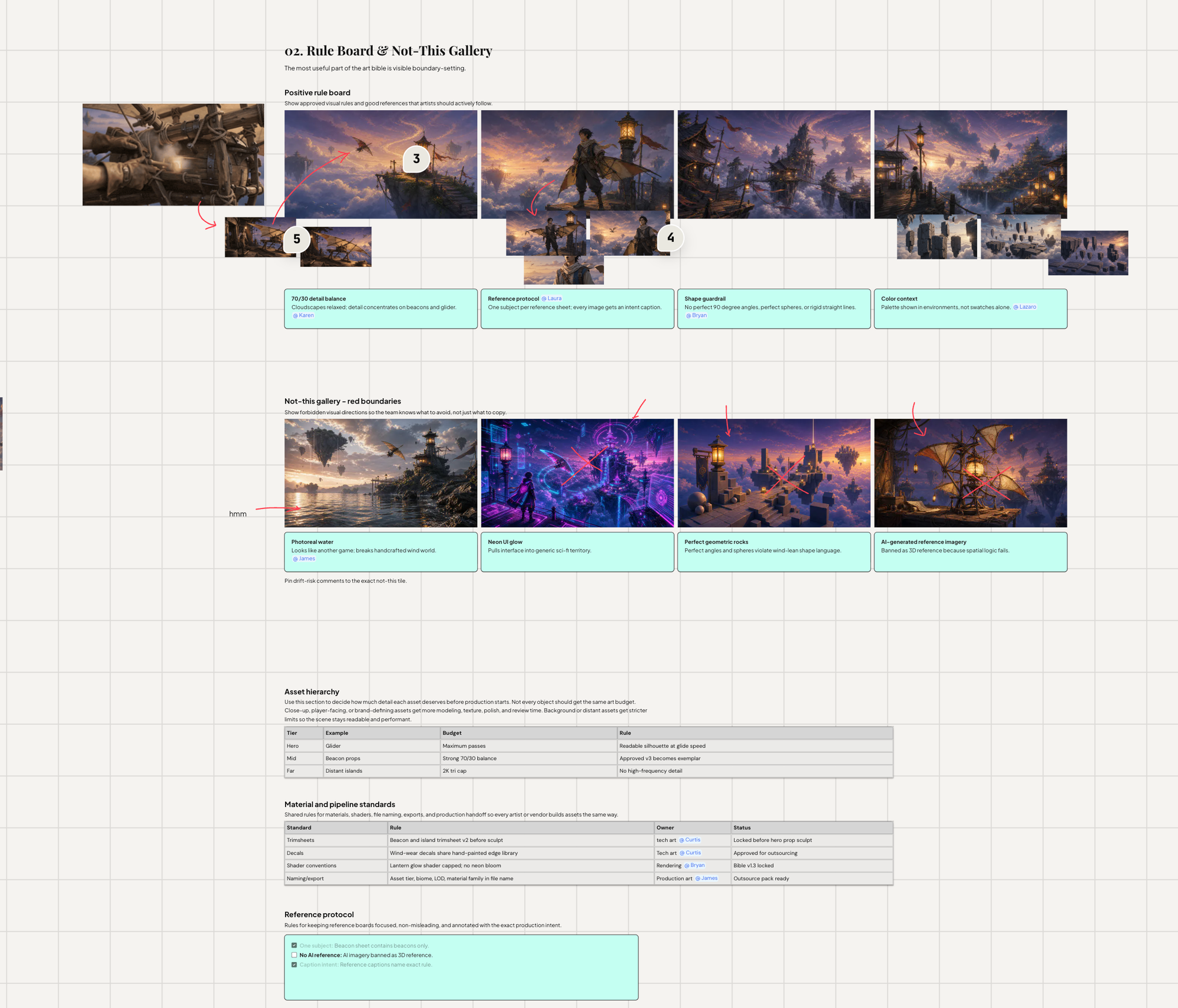
ALLO is a canvas for that moment. The options go up side by side with the brief and the references. Feedback attaches to the thing it is about instead of floating in a thread. The team can see all of it at once, argue in front of the work, and commit. The decision stays next to what earned it, so six months later the reasoning is still there.
It does not generate the work. Make it wherever you already make it.
The models will keep improving, and the average they hand you will keep getting better. It will also keep being the average. The only thing that will make your work look like yours is that somebody chose.
FAQ
Why does AI-generated content all look the same? Models return the most probable output, which is an average of their training data. Teams prompting similar models in similar ways get similar results. Figma's Dylan Field describes the first AI output as generic by definition.
Does AI make teams less creative? Individually, no. A 2024 study in Science Advances by Doshi and Hauser found AI-assisted writing was rated more creative than unassisted work. But the assisted pieces were more similar to each other, so collective originality dropped even as individual quality rose.
How do you stop AI work from looking generic? Someone has to reject the average. That means a person or a team looking at the full set of options together, comparing them directly, and committing to the one that is not the safest, with reasons.
What is "AI slop"? Merriam-Webster's 2025 word of the year, defined as low-quality digital content produced in quantity by AI. It describes output that is technically fine and completely forgettable.
Does ALLO replace Figma or Miro? No. Keep making work in Figma and running workshops in Miro. ALLO is where the options get compared and a direction gets chosen, after the making and before the shipping.