Level Design Document Template: Prove the Pacing Before You Build a Wall
A level design template that puts intent and a beat chart before geometry, so pacing is proven on paper while it still costs nothing to change.


When Valve playtested Half-Life: Alyx, one number changed how they built the game. An encounter that took 10 to 20 seconds on a normal build took 1 to 2 minutes in VR, because players moved their real heads to look around cover. So Valve rebuilt the enemy counts, the spacing, and the frequency of fights around how players actually behaved, not around how the level looked on paper.
That is the case for writing a level document a certain way. You cannot judge pacing by looking at a space. You have to prove it, and you have to prove it before anyone builds a wall, because geometry is the expensive thing to change.
Most level documents skip this. They describe the layout and the art and the enemy placements, and they call that a plan. Then the level gets built, it plays flat, and no one can say why, because the pacing was never written down as anything you could test.
Start with the idea, not the map
Before any geometry exists, a level has to answer two questions. What is this place, and why is the player here. id Software uses exactly these on Doom. If a level cannot answer both, it is a corridor with decoration.
So a good template puts the idea first and the map last.
The one-page intent. The level's identity, its constraints, its one core feature, and a clear definition of done. Everything built later gets judged against this page. If the map contradicts the intent, the map is wrong.
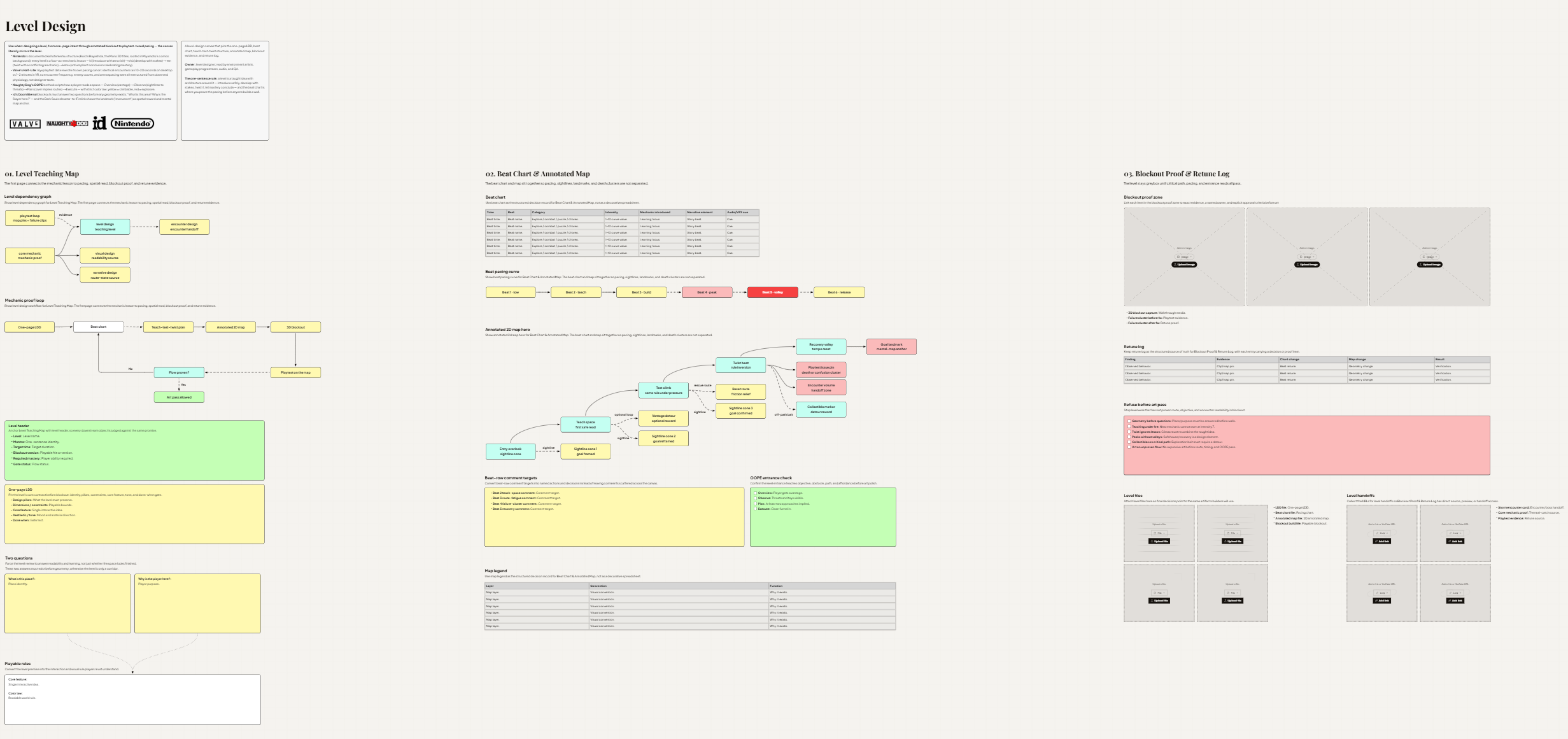
The beat chart. This is the part most templates are missing, and the reason they fail. Before blockout, you lay the level out as a sequence of beats and prove the rhythm on paper, while it still costs nothing to change. This is where the Alyx lesson lives.
The blockout. Now the geometry, annotated with how a player is meant to read the space. Only after the pacing holds up.
The retune log. After playtest, what changed and why, so observed behavior can overrule the designer's assumptions.
Build the level as a lesson
The strongest levels teach the player something, and that teaching has a shape. Nintendo's 3D Mario levels, structured by designer Koichi Hayashida, treat each level as four moves. Introduce a mechanic somewhere safe, so the player learns the rule without being punished. Develop it with real stakes. Twist it, so the player has to rethink what they learned. Then end on a beat that lets them feel they have mastered it.
Your beat chart should read like that. Introduce, develop, twist, master. Not a list of rooms.
The template, as a canvas
Sign up ALLO to use free templates
A level is spatial, so the plan should look like the level rather than like a stack of pages. The template opens with the one-page intent, then the beat chart as a sequence you can rearrange while you test it, then the annotated map and blockout sitting right beside the intent. That layout forces a reviewer to judge whether the level teaches and reads well, not just whether it looks finished. The environment artists, programmers, audio, and QA all work from the same canvas.
FAQ
What is a level design document? The plan for a single level: its core idea, the mechanic it teaches, its pacing, and an annotated blockout. The level designer writes it, and artists, programmers, audio, and QA read it.
What is the most important part of a level design document? The beat chart. It proves the level's pacing before any geometry is built, when changes are still cheap. Weak documents describe the space but never test the rhythm.
How should a level teach a mechanic? Introduce it somewhere safe, develop it with stakes, twist it so the player rethinks it, then end on a mastery beat. Nintendo's 3D Mario levels are the clearest example.
Why use a canvas instead of a document? A level is spatial, so the plan should mirror it. A canvas keeps the beat chart, the annotated map, and the blockout next to the level's intent, where a document separates them onto different pages.
--
A level design document is the plan for a single level: its core idea, the mechanic it teaches, the pacing of its beats, and an annotated blockout. Most are written to describe what a level looks like. A good one proves how the level plays before any geometry is built, using a beat chart. The free ALLO template below is built around that sequence.