Companies Bought AI to Move Faster. Now They Can't Decide Anything.
AI made producing work cheap. It also buried teams in options nobody can choose between, and that is where the returns are disappearing.


AI can produce ten campaign directions before a team finishes discussing the first one. Specs, layouts, images, code, all of it in minutes.
The returns are not showing up. PwC's 29th Global CEO Survey, published in January 2026, found that 56% of CEOs had seen neither higher revenue nor lower cost from AI in the past year. Only 12% reported both. MIT's Project NANDA looked at more than 300 AI deployments in 2025 and found roughly 5% of integrated pilots producing real value, after an estimated 30 to 40 billion dollars in spending.
Something is eating the gains between the output and the result.
The cost that disappeared, and the one that didn't
Making another version used to cost a day of someone's time. That cost quietly capped how many options ever reached the table. You made two. You picked one, and picking felt easy because there was almost nothing to pick between.
AI removed that cap and nothing else. The options now arrive by the dozen, and the team still has to look at all of them, disagree, and land on one. That work never got faster.
BetterUp Labs and Stanford's Social Media Lab put a number on the waste in 2025. In a survey of 1,150 US workers, 40% had received AI output in the past month that looked finished but did not move the work forward. Each instance cost the recipient just under two hours. They called it workslop.
Forty options that are all slightly the same
Choosing is harder than it should be because the options are more alike than they look.
Dylan Field, Figma's CEO, explained why on Lenny's Podcast in October 2025: the first thing AI gives you is generic by definition, because it is the average of everything it has seen. Teams prompting similar models get similar results. Merriam-Webster made "slop" its 2025 word of the year, defined as low-quality digital content produced in bulk by AI.
Which means the only thing separating your work from a competitor's is that someone looked at the pile and made a real choice. That used to be the last five minutes of a project. Now it is most of the value.
The meeting where nothing happens
Someone brings thirty AI options. They are all fine. Everyone has a slightly different favorite, nobody wants to kill the other twenty-nine, and the meeting ends with "let's sit with it." The options go in a folder and nobody opens it again.
The team is not the problem. It has nowhere to do this.
The options live in a Slack thread, stacked in a line, so by the time you reach the fifth you have lost the first. Or they sit in Drive, one file at a time, compared from memory. David Kirsh at UC San Diego has spent decades studying how people reason with things outside their heads, and the finding is simple: people think better when they can see everything at once, in front of each other. A thread cannot do that. Neither can a folder.
So the call gets made by whoever talks longest, or by whoever outranks everyone, or the deadline makes it. Weeks later someone asks why the team went that way and nobody can find the reasoning, because it was never anywhere. Only the conclusion survived, as a task.
Reviewing is not choosing
Reviewing is one person judging one thing against a standard. Plenty of tools do that well.
Choosing is a group in front of many workable options, arguing, and committing to one. AI made the first kind of work explode and the second kind decisive.
What to measure
Most companies count users, prompts, and drafts. Those numbers tell you the machine is on.
Better ones: how long to a decision, how many rounds, how much of what you generate ever ships. A team that produces a hundred drafts and approves two is not beating a team that makes five and commits to one.
Keep your tools
Design in Figma. Store files in Drive. Run tickets in Jira. Hold your workshop in Miro.
The gap is between those tools, at the moment work stops being made and starts being decided.
What we built
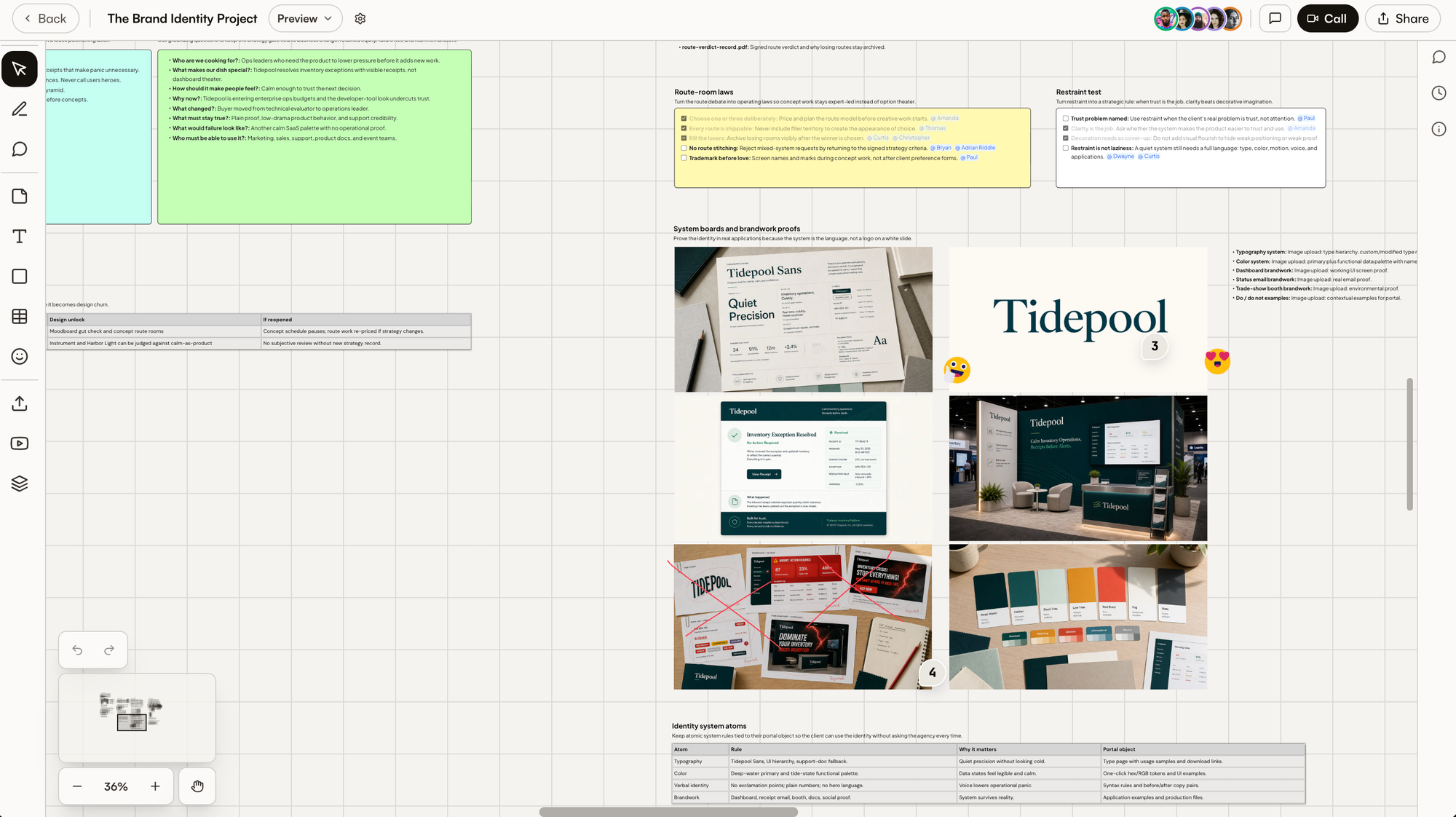
ALLO is a canvas for that moment. The options go up side by side with the brief and the references, feedback attaches to the thing it is about instead of floating in a thread, and the team argues in front of the work until it settles. The decision stays next to what earned it.
It does not make the work. Make it where you already do. It is not an approval queue either.
Models will keep getting cheaper, and generating things will stop being an advantage, because everyone will have it and everyone will get back the same average. What is left is deciding which of the forty is right, and getting a team to agree.
FAQ
Why doesn't AI improve team productivity? It speeds up one person's output and increases what everyone else has to judge. The 2025 BetterUp Labs and Stanford study found 40% of workers received AI output that looked finished but was not, costing nearly two hours each time.
Why does AI-generated work look the same everywhere? Models return an average of what they have seen. Figma's Dylan Field calls the first output generic by definition. What makes work distinct is a person choosing a direction.
Is choosing the same as reviewing? No. Reviewing judges one piece of work. Choosing means picking one direction from many viable ones and getting a team to agree.
Does ALLO replace Figma, Jira, or Drive? No. Keep them. ALLO sits between making the work and executing it, where the options get compared and a direction gets set.
How is ALLO different from Miro or FigJam? Those are built for workshops, and the boards get abandoned when the session ends. ALLO holds a project's options, versions, feedback, and decisions as the work continues.
How do we know if AI is paying off? Not by counting prompts. Time to decision, number of review rounds, and how much generated work actually ships.