Game Design Document Template: The Living GDD Real Studios Use
A practical game design document template built around pillars, core loop, feature briefs, scope matrix, and decision log, kept as a living hub instead of a static bible.


What a game design document template is
A game design document, or GDD, is the shared record of what a game is and how it works. It holds the pitch, the design pillars that break ties, the core gameplay loop, a brief for each major feature, the scope and economy numbers, and a log of decisions and why they were made.
The old model was the monolithic GDD, the hundred-page bible in the Deus Ex or GTA tradition. In current practice that model is functionally dead. Nobody on a shipping team reads a hundred pages, and the moment the build moves, the document is wrong. What replaced it is a living hub: indies converged on one shared workspace that holds the GDD, the tasks, and the assets together, and mid-size studios wire their design pages to engineering tickets so that changing a mechanic automatically flags the epics it touches.
The test is simple. The GDD is a hub the team works in, not a document the team works from. If it has drifted from the build, the document has already failed.
Game design document example: how real studios structure it
The useful examples are structural, not prose. Larian planned Baldur's Gate 3 with systemic artifacts rather than paragraphs, including logic matrices for how every D&D class intersects every scene, because prose cannot hold that many interactions. miHoYo runs character-first design on Zenless Zone Zero, where personality and visual identity are written and locked first, and the combat is designed to match, so the design hub records which direction leads. The shared lesson is that mechanics are visual. A core loop diagram and a scope matrix do more work than a page of description.
What to include in a GDD
Use the autocomplete variants as your checklist. A complete template covers:
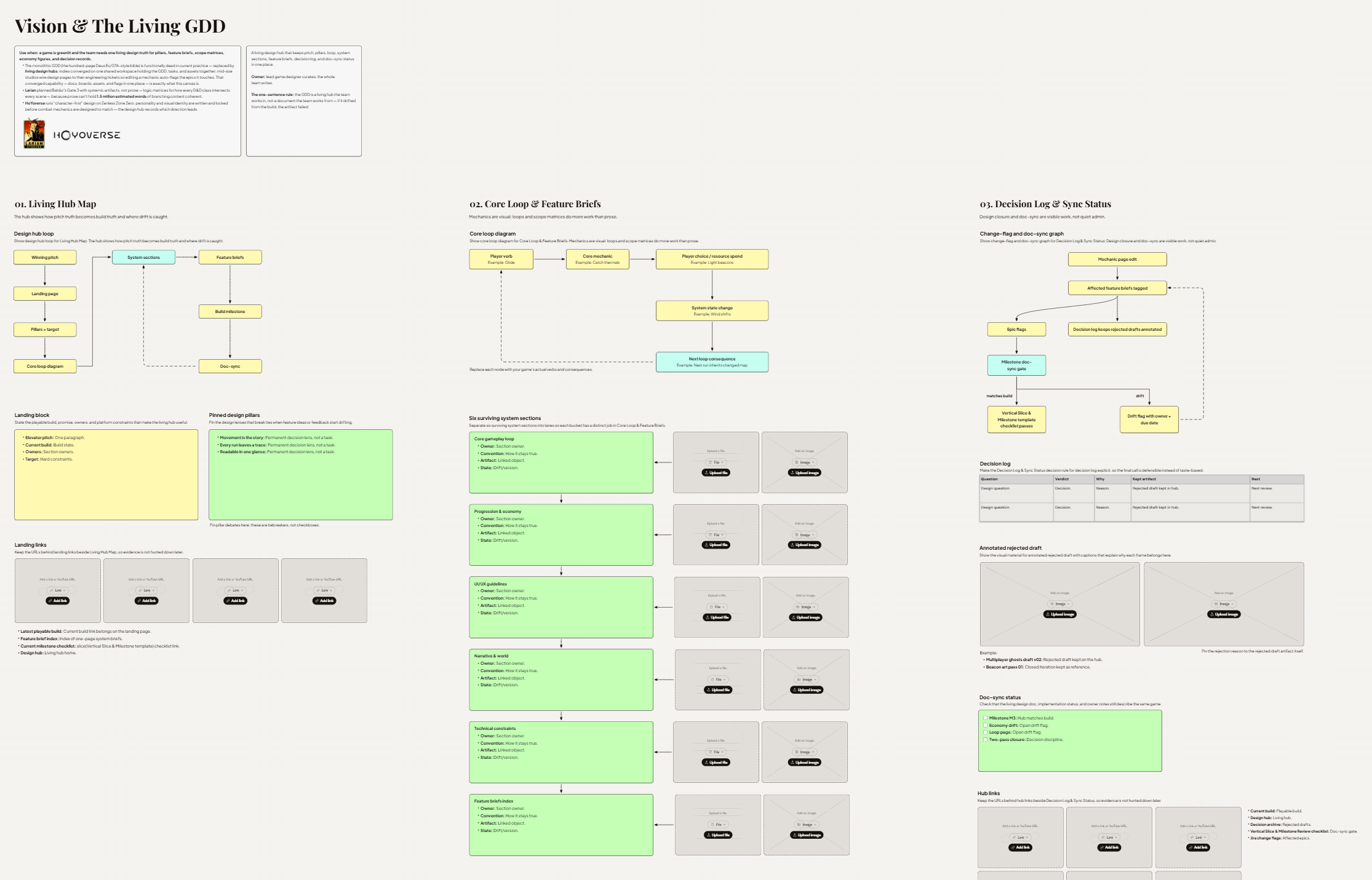
- Vision and pillars. The playable promise, the owners, the platform constraints, and three to five design pillars that act as tiebreakers when feature ideas start drifting. Pillars are for settling arguments, not for decoration.
- Core loop. A diagram of what the player does, how that action changes the game's state, how the state carries into the next loop, and how the player reads the consequence. Replace the generic nodes with your game's actual verbs.
- Feature briefs. One card per major mechanic, each carrying a player promise, its dependencies, its logic, and a short summary, so a feature is buildable rather than vague.
- Scope matrix. The structured source of truth for what is in and out, with every entry attached to a decision or a piece of proof.
- Decision log and doc-sync status. A record of what was decided and whether the document still matches the build. Keeping the design in sync is visible work, not quiet admin.
Game design document template: free ALLO canvas
Sign up ALLO to use free templates
It opens as a living hub map showing how the pitch becomes the build and where drift gets caught. The pillars are pinned as tiebreakers, the core loop is a diagram you fill with your own verbs, the feature briefs are cards, and the scope matrix and decision log sit beside them. Reference URLs stay pinned next to the work, so evidence is not hunted down later. Because it is a canvas, the whole team can be in it at once, which is the point of a living hub rather than a file that gets exported and goes stale.
GDD template for Notion, Google Docs, and one-page formats
If you keep your GDD in Notion or Google Docs, the same structure applies: pillars, loop, feature briefs, scope, decision log. What those tools cannot do well is hold the visual artifacts, the loop diagrams and scope matrices, next to the text and the tasks, or flag downstream work when a design changes. A one-page GDD is a good starting point for a small game or a game jam, and the ALLO template collapses to that: the vision page alone is a usable one-page GDD, and you expand the sections as the project grows.
FAQ
What is a game design document? The shared record of what a game is and how it works: pitch, pillars, core loop, feature briefs, scope, economy, and decisions. Modern teams keep it as a living hub they work in, not a static document.
Is the hundred-page GDD dead? For most teams, yes. The monolithic bible is too slow to read and drifts from the build immediately. Studios replaced it with a shared workspace holding the design, tasks, and assets together.
What should a GDD include? Vision and pillars, a core loop diagram, a feature brief per mechanic, a scope matrix tied to decisions, and a decision log with doc-sync status.
What is a one-page GDD? A single-page version covering the pitch, pillars, core loop, and constraints, used for small games and game jams. It is the natural starting point that a fuller GDD grows out of.
Can I use Notion or Google Docs for a GDD? Yes for the text. The limit is that document tools do not hold visual artifacts next to the design or flag the work a change affects, which is why teams move the hub to a canvas.
---
A game design document template is the structure a team uses to hold a game's design truth in one place: vision and pillars, the core loop, feature briefs, a scope matrix, economy figures, and a decision log. Modern studios no longer keep this as a static hundred-page document. They keep it as a living hub the team works in, wired so that editing a mechanic flags the work it affects. The free ALLO template below is that hub, ready to copy.